Where
to See Florida Birds
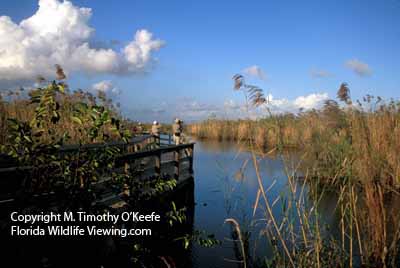
The
Anhinga Trail boardwalk, one of my favorite birding locations in all
of Florida
For decades the birding hotspot for viewing wading birds in all of America has been Everglades
National Park, the largest remaining subtropical wilderness
in the continental United States.
Another
excellent birding site is the 11,000-acre Corkscrew
Swamp Sanctuary in Southwest Florida, just north of
Naples, owned and operated by the National Audubon Society.
The following are other prime birding sites located throughout Florida.
Florida Keys
The
Florida Keys are also an excellent spot for finding birds not only on
land but offshore, in the Gulf Stream. The Gulf Steam
flows into Florida from the Caribbean, bringing with it many pelagic
species that are rarely if ever viewed from shore.
In the Keys, the Gulf Steam may be as little as 5 or 10 miles from shore,
but the problem is getting there: organized pelagic birding trips are
rare. Unless you can afford to charter a boat of your own, the best
way to get to the Gulf Steam is aboard a "party" or "head"
boat filled with bottom fishermen.
You might as well bring along a rod with the binoculars. There are no
guarantees of success, so a half-day trip is the best way to approach
the matter. Party boats leave from Islamorada, Marathon and Key
West.
Visit
A Heronry
In
spring and summer, one of the best ways to see large numbers of birds
is to visit a heronry, where both white and great blue
herons often congregate in the hundreds and sometimes thousands. Be
sure to bring binoculars or a spotting scope since you're allowed to
get only so close to a heronry.
The
great blue heron often shares its nesting territory
with the tri-color heron, little blue heron, green heron, the yellow-crowned
and black-crowned night heron, the snowy egret,
the great egret, anhinga, and sometimes even wood ibis.
In
South Florida, these species may be joined by what are sometimes called
"big white herons." These actually are great blues in a white
phase. The body is totally white; the bill, legs and feet are yellow;
and the eye has a bluish-green patch around it. This white phase is
peculiar strictly to South Florida.
One
of the easiest nesting bird colonies to reach is at J.N. "Ding"
Darling National Wildlife Refuge on Sanibel Island in Southwest
Florida. It's located at the end of the wildlife drive (closed Fridays)
where egrets, great blue herons and several other varieties are perched
on fragile-looking limbs over the water. Avoid weekends since this is
the most visited refuge in the nation.
Canoe trips into the backcountry are easy to arrange. For information,
call 813/472-1100. This is also an excellent area to see many other
different types of Florida birds and reptiles. Some people claim Ding
Darling is almost as good as the Everglades.
The number of active heronries in a single season at Loxahatchee
National Wildlife Refuge is staggering: over 250 in good years.
Each heronry differs dramatically in the number of birds. Some are small,
but others contain thousands of nesting herons, egrets and ibis. Many
of the rookeries are difficult to reach, but the one behind the refuge
office on Marsh Trail seems like it was placed just for the benefit
of visitors. Expect to see as many as a thousand birds present at the
peak of the nesting season. Take I-95 to the Boynton Beach Blvd. exit
and go west to U.S. 441.
The
islands at Cedar Key National Wildlife Refuge, located
about a two hour drive north of Tampa, contain one of the largest heron
nesting grounds anywhere in the South. Boat tours are easy to arrange,
and a few operators specialize in trips for birders. Contact the Chamber
of Commerce at 904\543-5600.
Merritt
Island National Wildlife Refuge near Titusville is one of the
Southeast's great nesting grounds for herons: tri-colored, great blue,
little blue and green herons, plus ibis and egrets. This location is
considered to have the best assembly of all the different species anywhere
on the entire U.S. East Coast. Check at the refuge center for location
of the most accessible nests; 407/867-0667. This is also a great place
for wintering waterfowl,
beginning in November and peaking in January.
To Everglades Birding Sites
To Birding at Corkscrew Swamp
|
