Essentials
Home
Where to Go
When to Go
Animal Facts
Photo Gallery
Photo Tips
Kids' Corner
______________
Activities
Florida Birding
Birding Optics
Florida Camping
Kayaking
Nature Festivals
Florida Hiking
Nature Webcams
______________
Florida Travel
Florida Ecotourism
Travel Insurance
Florida Maps
Florida Weather
___________
About Us
Disclaimer
Copyright Notice
Site Search
|
|
Too Many People,
Too Few Sea Turtles
Adult turtles are of such a size that they have few natural enemies.
The need to bury the eggs on land has always been the sea turtle's greatest
vulnerability.
A
sea turtle on shore has always been a turtle at risk.
In the past, there was a natural balance at work as long as the traditional
nesting sites were left intact. It was the arrival of Europeans
that changed the balance in our part of the world.
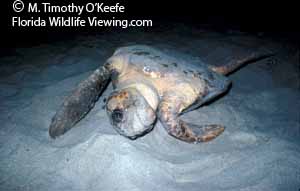
A sea turtle on its back is totally helpless
Early European explorers quickly recognized that sea turtles were an ideal fresh
meat source. On sailing voyages, turtles could be kept
alive indefinitely aboard ship by keeping them on their backs.
Eventually, turtles became popular food in Europe. In England, the clear
soup made from the green turtle soon became
a status symbol at important banquets.
Green
turtles, incidentally, are not named for their external coloration,
which is commonly olive-brown with dark streaks, but
from the color of their body fat which was once made
into soup.
Not
only were sea turtles over-exploited for food, many
of their prime nesting beaches were destroyed by development.
Today, all species of sea turtles except the loggerhead
are classified as endangered.
The loggerhead is a threatened
species.It
is not only illegal to kill sea turtles for their meat
or to steal their eggs, it is illegal to import turtle products into
the U.S.
To Florida Animals & Wildlife Home
To Where to See Nesting Sea Turtles
To Sea Turtle Homepage
|
|
